Statewide coverage
SEO & Digital Marketing Agency in Washington
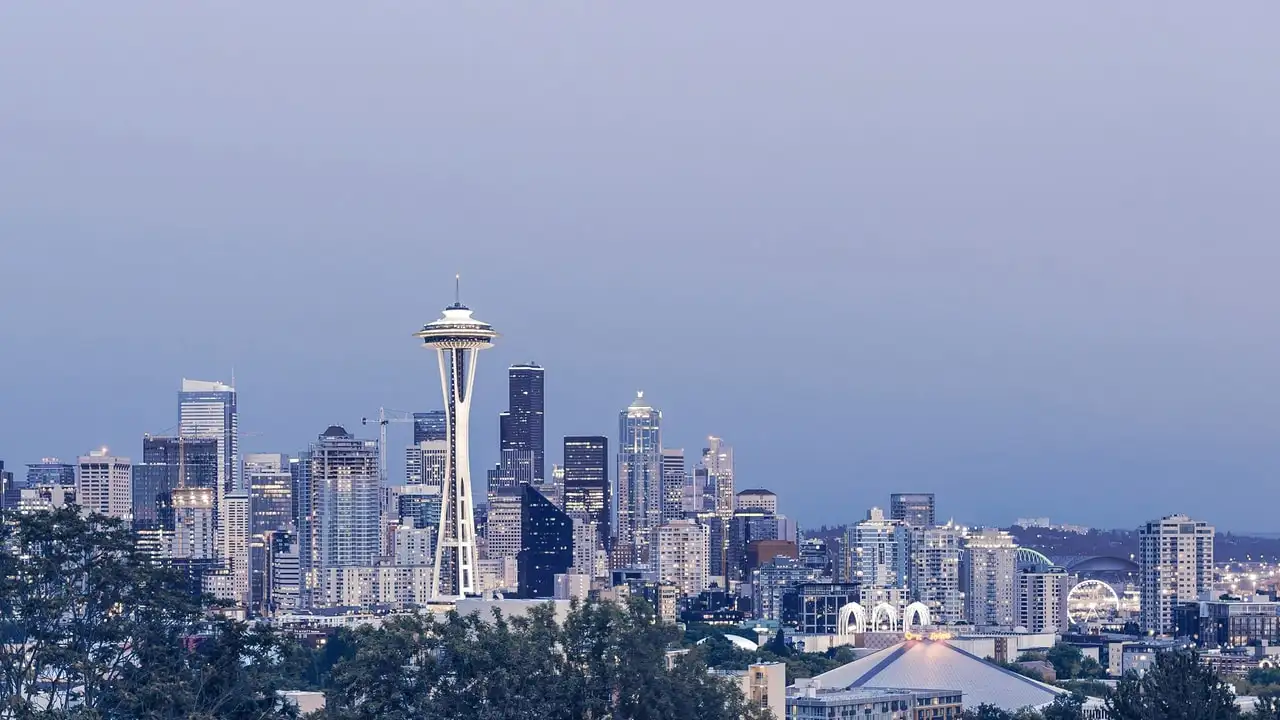
Seattle has solid but not saturated competition, with a handful of established local firms and national agencies running geo-targeted Seattle pages from elsewhere. The larger structural feature is the split: Puget Sound is contested, while Spokane and Eastern Washington have limited agency presence relative to their commercial activity — and the Cascades divide the state into two markets that share almost no search behaviour.
- Competition
- Moderate competition
- Main cities
- 4
- Services covered
- 12
- Zip codes named
- 4
Inside Washington
The places that shape how Washington searches
Geography and local identity change what works here. These are the specific features we plan around.
-
district The Eastside — Bellevue, Redmond, Kirkland
The Eastside — Bellevue, Redmond, Kirkland
A large, affluent market across Lake Washington that functions independently of Seattle. Locals treat the lake as a genuine boundary, and search behaviour follows it.
-
district The Seattle neighbourhood belt
The Seattle neighbourhood belt
Ballard, Fremont, Capitol Hill and Queen Anne, where strong neighbourhood identity combines with hills and water that make cross-town travel slower than the distances imply.
-
corridor The Cascade divide
The Cascade divide
The mountain range splitting the state into two economies. Spokane and Eastern Washington have almost nothing in common with the Puget Sound market and are consistently under-served.
Search characteristics
How Washington actually searches
What changes about search, competition and cost once you are inside this market.
How people in Washington search
Seattle has strong neighbourhood-level search behaviour reinforced by geography — hills, water and bridges make cross-town travel genuinely slow, so drive-time bounds the addressable market more tightly than a map suggests, and residents search Ballard or Capitol Hill rather than Seattle. The Eastside operates as a separate market entirely. Seasonality is unusual: the long grey winter suppresses some discretionary categories while the short summer produces sharp, brief spikes in outdoor, home-improvement and recreation demand.
What we know about this market
Two features of this state consistently surprise businesses expanding into it. First, Lake Washington is a real market boundary rather than a geographic detail — Seattle and Bellevue are separated by bridges that are genuine bottlenecks, and locals treat the Eastside as a distinct place. A Seattle-registered listing will not hold position in Bellevue for competitive consumer categories, and Eastside residents search Bellevue, Kirkland or Redmond specifically. Second, the Cascades split the state into two economies that share very little. Spokane anchors a substantial Eastern Washington market with agriculture, healthcare and distribution, and it has noticeably thinner competition than its size warrants because agency attention concentrates entirely on Puget Sound. A business serving Eastern Washington is competing in a genuinely different and considerably cheaper market.
Paid search cost pressure
Seattle technology keywords compete against national advertisers, which pushes costs above what the local market size implies. Legal and home services are competitive but below California rates. Spokane and Tacoma cost substantially less for equivalent intent.
Coverage
Cities, neighborhoods and zip codes we cover in Washington
Naming these matters: coverage claims a business cannot support are both a ranking liability and a trust problem when somebody calls from an area you cannot reach.
Main cities
- Seattle
- Spokane
- Tacoma
- Bellevue
Key districts
- Downtown Seattle
- Capitol Hill
- Ballard
- Fremont
- Downtown Bellevue
- Tacoma Waterfront
Zip codes
- 98101
- 99201
- 98402
- 98004
Washington services
What we do for Washington businesses
12 services, each with a dedicated Washington page. The note under each one is specific to this market — it stops being true if you swap the place name.
SEO Services in Washington
- Local SEO in Washington Lake Washington as a hard ranking boundary
- Website SEO in Washington The Eastside treated as a service-area extension
- AI SEO in Washington The earliest-adopting buyers, and therefore the earliest-moving competitors
- Technical SEO in Washington Client-rendered content invisible to the retrieval systems buyers use
- Social Media Management in Washington A winter with nothing to produce and a summer with no time to produce
Web Design in Washington
- Custom Website Design in Washington Client-rendered builds in a market of early AI adopters
- App Design in Washington A high internal bar set by regional product culture
- Website Redesign in Washington Rebuilds that carry the rendering problem forward
- Landing Page Design in Washington A lake crossing that a Seattle headline ignores
Proof
What we can stand behind
One documented client result, two facts about how we work, and the market data that explains why local and AI search matter right now. Each figure is labelled with what it actually is.
- Documented client result 84%
Organic traffic increase in 3 months
- Company history 10+
Years running search and paid campaigns
- Service model 3
Disciplines under one roof — SEO, paid media, web design
The 84% figure is a documented result for one client, not a projection of typical performance in this or any market. The market figures are published statistics from the sources named.
See the before-and-after data: our fence contractor SEO case study
Nearby areas
Markets adjacent to this one
Adjacent does not mean interchangeable — proximity decay, competitive density and seasonality all differ across these boundaries.
Frequently Asked Questions
Why does Bellevue need separate content from Seattle?
Because Lake Washington is a genuine market boundary, not a geographic footnote. The bridges connecting Seattle to the Eastside are real bottlenecks, and the resulting travel time means an Eastside resident is not crossing over for a routine service — so they search Bellevue, Kirkland or Redmond specifically, and locals talk about "the Eastside" as a distinct place with its own centre of gravity. Proximity decay reinforces this: a Seattle-registered Google Business Profile will not hold position in Bellevue for competitive consumer categories regardless of how the service area is configured. The Eastside is also affluent and commercially dense, with a substantial technology and professional services base, so this is a large market rather than a suburban afterthought. Businesses serving both routinely run one Seattle page and find themselves invisible across the lake, which is not a configuration problem — it requires genuine organic content about serving the Eastside.
How does Seattle's geography affect local search strategy?
More than in most cities, because hills, water and a limited number of crossings make travel times substantially longer than the distances suggest. A trip that looks like fifteen minutes on a map can take forty, and consumers price that in — which bounds the realistic addressable market for a physical business to its own part of the city rather than the metro. This is why neighbourhood identity is so strong here and why residents search Ballard, Fremont or Capitol Hill rather than Seattle. The practical implications are that neighbourhood terms carry real commercial volume, that a single city-level page leaves most of the addressable demand uncovered, and that pursuing citywide visibility distributes effort across areas you cannot realistically serve. Covering the three or four neighbourhoods your customers actually come from produces meaningfully more revenue than thin visibility across the whole city.
Is Spokane genuinely a better opportunity than Seattle?
For businesses that can serve it, frequently yes, and the reason is structural. The Cascades divide Washington into two economies that share very little beyond a state government, and agency attention concentrates almost entirely on Puget Sound — national agencies build for Seattle because that is where the volume and the fees are, and local independents cluster there too. Spokane anchors a substantial Eastern Washington market with agriculture, healthcare, distribution and education, and it has noticeably thinner competition than its size warrants. The consequence is that city-level head terms which would be a long project in Seattle are contestable in Spokane, content depth requirements are lower, and paid costs run well below the Puget Sound equivalent for the same intent. Tacoma sits in a similar position on the west side — large, commercially active, and consistently under-served relative to its proximity to Seattle.
How should Washington technology companies approach SEO differently?
By recognising that they are competing nationally, which removes local SEO from the picture almost entirely. A Seattle or Bellevue software company selling to buyers anywhere gains nothing from map pack position, Google Business Profile optimisation or neighbourhood content — yet those are frequently sold to them because the default agency playbook is local. What matters instead is topical authority in the subject area, content that competes with well-resourced national players, technical performance at scale, and increasingly AI citation presence, since technical buyers adopted generative search for research earlier than most audiences. The competitive set is also entirely different: you are not competing with other Seattle companies but with everyone selling the same category anywhere, which means the content bar is set nationally rather than regionally. Diagnosing which side of this line a Washington business sits on is the first decision in the engagement, and getting it wrong is expensive in both directions.
What does Washington's seasonal pattern mean for campaign planning?
It runs opposite to the pattern in our home market and needs planning around rather than ignoring. The long grey winter suppresses discretionary and outdoor-adjacent demand for a genuinely extended period — longer than a Florida or Georgia business would expect — so flat budget pacing overspends against reduced demand for months at a time. Then the short, reliable summer produces sharp spikes in outdoor recreation, home improvement, landscaping, roofing and event categories, concentrated into a window measured in weeks. Those spikes cannot be captured by content published during them, because indexing and ranking take longer than the window lasts, so the organic groundwork has to be established through the winter. For paid campaigns the requirement is concentrating spend into the demand window rather than distributing it evenly, which usually means asking for a budget that varies substantially month to month — and in seasonal categories that is one of the larger efficiency gains available.
Coverage area
Serving Washington and Surrounding Neighborhoods
Our team works from St. Petersburg, FL, and covers Washington alongside the surrounding communities below.
Neighborhoods and communities we cover
- Downtown Seattle
- Capitol Hill
- Ballard
- Fremont
- Downtown Bellevue
- Tacoma Waterfront
Zip codes served
- 98101
- 99201
- 98402
- 98004

Find out what it takes to win Washington
We will audit your current visibility against the competitors actually ranking in Washington, and tell you honestly which channel your budget belongs in — including when the answer is that the auction economics do not work.