What “near me” actually means to Google (and it is not your address)
Type “seo company near me” into a phone and Google does not go looking for listings with the words “near me” in them. It reads two things: what you are asking for, and where the phone is standing. The phrase itself is discarded and replaced with a coordinate.
That single mechanic explains most of the confusion around near-me visibility. Google’s own account of local ranking names three inputs — relevance, distance and prominence — and distance is measured from the searcher, or from the place name if they typed one. Your registered address is one end of that measurement. It never sets the centre.
So “how to rank for near me searches” is not really a keyword question, because there is no near-me keyword to rank for. There is a set of coordinates the customer occupies, and the question of whether you are close enough and credible enough at that point. Asked that way the answer changes shape: you are not chasing a ranking position, you are looking at a coverage area with edges.
Which is why checking your rankings from your own desk tells you almost nothing. You are standing on the one point where you perform best, and every customer who says they cannot find you is standing somewhere else.
Tampa Bay breaks the radius model: water, bridges and 40-minute drive times
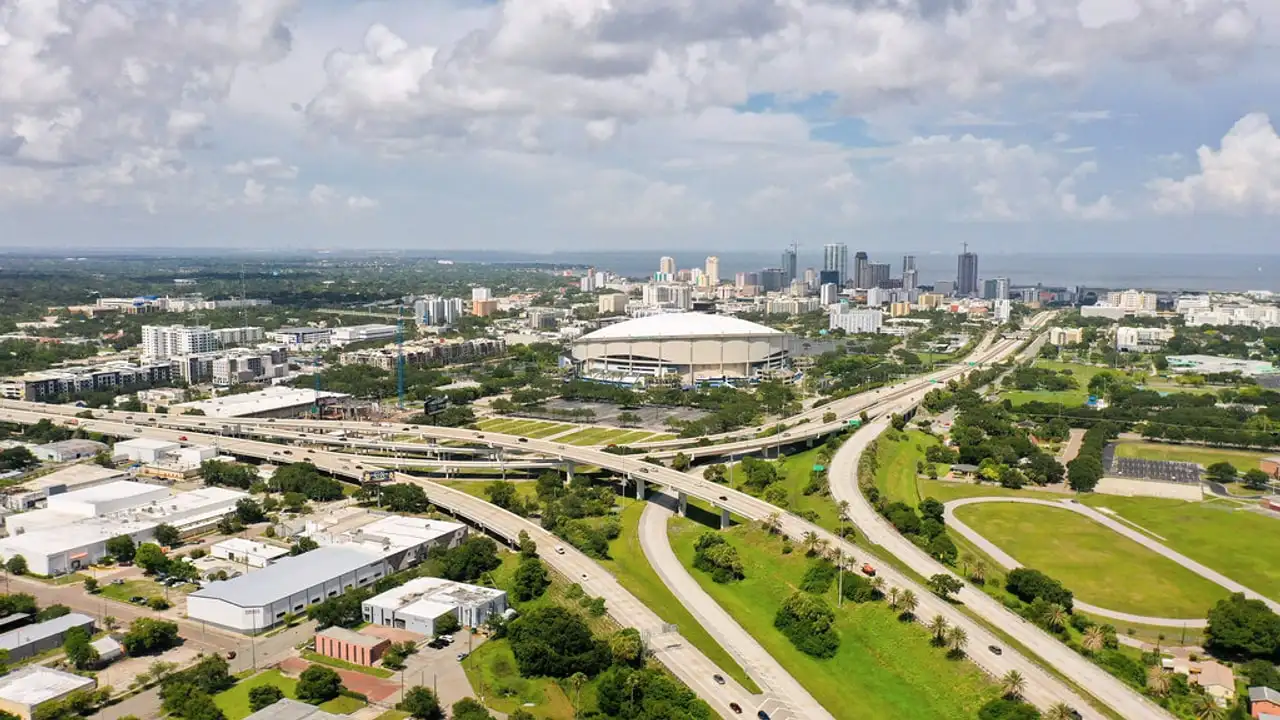
Most local SEO advice quietly assumes a radius — draw a circle around your pin and that is roughly your reach. In a gridded inland city the approximation holds well enough. Around Tampa Bay it collapses, because the bay sits in the middle of the market.
A business near Gandy Boulevard in St. Petersburg is a short straight line from the Westshore district of Tampa. It is also, in every sense a customer cares about, on the other side. Three crossings connect the counties: the Howard Frankland carrying I-275, the Gandy to the south, and the Courtney Campbell to the north. Everything else is a long detour around the top of the bay. Those few miles of open water are twenty-five minutes of driving in good conditions and considerably worse at the hours people actually book work.
The result surprises owners every time. A St. Pete company can sit closer to a Tampa searcher in a straight line than a Brandon competitor does and still be invisible there — while being outranked in Pinellas Park by a company farther away by road that happens to be on the same side of the water with stronger local signals. Distance is one of three inputs, it is not a straight line, and it never operates alone.
Two readings follow. Hillsborough is a separate market for a Pinellas business, entered through organic pages and paid search rather than by adjusting a profile. And inside Pinellas the smaller barriers still bite: the beach communities sit behind the intracoastal with a handful of bridges across it, so coverage toward Treasure Island and St. Pete Beach thins faster than the mileage suggests.
The three ranking inputs you cannot control
Before spending money, separate what is fixed from what is movable. Three things here are fixed.
Where the searcher is standing. This is the centre of every near-me query, it changes with every search, and nothing in your marketing touches it. Someone in a Westshore office tower and someone in a Kenwood bungalow are running two different searches with identical words.
The point Google measures your distance from. For a verified business, that is your address. Hiding the address and running as a service-area business removes the pin from public view; it does not appear to move the point distance is calculated from. The service area you list tells Google and customers where you are willing to travel. It is not a radius setting.
Competitor density around that searcher. Ten agencies within two miles of downtown Tampa means the bar for three map slots there is set by them, not by you. The same profile that struggles in a dense corridor can dominate a thinner one a few miles away.
You can work around all three. You cannot change any of them, and a plan that implicitly assumes otherwise — usually by promising map pack coverage across a whole metro from one address — is promising something the mechanism does not do.
The four you can: category, service area, prominence, on-page proximity signals
Primary category. The strongest relevance lever on the profile and the one most often set carelessly. Category filtering happens before distance does anything, so a business filed under a broad or adjacent category is competing in the wrong pool everywhere at once. Pick the category that names what you actually sell, add secondaries only where you genuinely deliver the service, and check both against whoever currently ranks for your target query.
Service area and profile completeness. Listing service areas will not extend your radius, but the rest of the profile still works: accurate hours, services with real descriptions, photos added on a regular cadence, questions answered. These raise how often you are treated as a strong match once you are inside the candidate distance. They do not lengthen the distance.
Prominence. The only lever with real effect on how far your reach extends. Review volume and recency, links from Tampa Bay sources, mentions on local sites, consistent citations and branded search all feed it. A business with substantially more prominence than the businesses surrounding a searcher can appear from farther away than they can. It is slow and it has a ceiling, but it is genuine — and it explains why two similar businesses at similar distances rarely rank alike.
On-page proximity signals. When the map pack radius runs out, organic results do not. The blue links below the map are far less distance-bound, which makes your website the only asset that reaches a Tampa searcher from a St. Pete address. That requires a page genuinely about that area — work completed there, neighbourhoods named the way residents name them, logistics you can describe accurately — not a city name dropped into a template. This is where local and website SEO meet, and where most of the achievable gain outside your home radius actually lives.
How to test your own near-me visibility across St. Pete, Tampa and the beaches
There are two workable methods, one paid and one free.
The reliable one is a geo-grid tool. You give it your business, a query and a set of points across a map; it runs the search from each coordinate and returns a grid of positions. That converts “we rank third” into a picture with a boundary on it, which is the only version of the answer worth having.
The free one is a browser. In Chrome, open DevTools, find the Sensors panel, override geolocation with a specific latitude and longitude, then run the query signed out in a private window. Repeat per point. It is tedious and less precise than a proper grid, but it is honest and it costs nothing.
What not to do is type “seo company near Tampa” from your desk. Adding a place name converts a proximity query into an explicit location query, which Google answers differently. You will get a result, and it will not be the one your Tampa customer sees.
For a St. Pete business, a useful set of points: your own address, downtown St. Petersburg, the Gateway and Carillon area, Pinellas Park, Gulfport, St. Pete Beach, Westshore, downtown Tampa and Brandon. Nine points across roughly thirty miles will show you your boundary in an afternoon.
When a second location is the honest answer — and when it is not
Sometimes the diagnosis really is geographic, and the only thing that moves the measurement point is a second measurement point.
A second location works when it is genuinely a second location: premises you or your staff occupy during stated hours, permanent signage a passer-by could photograph, a distinct phone number answered there, and an address that survives verification. Businesses that clear that bar earn a legitimate second profile and a real second coverage area.
It does not work as a shortcut. A mailbox, a virtual office, a registered agent address or a coworking desk rented for the postcard all fail the requirement that the location be staffed during business hours, and these are among the most reliably detected violations in local search. The downside is not a listing that ranks poorly; it is a suspension that sometimes reaches the original profile, and a reinstatement process measured in months.
The honest framing: a second location is a business decision that produces an SEO outcome, never the reverse. If Tampa work justifies a Tampa office on its own numbers, open one. If it does not, the answer is organic pages and paid search.
What realistic near-me coverage looks like from a 33702 address
Some concrete bands, so you can judge your own results against something.
From a 33702 address near 4th Street North, with a well-built profile, a correct category, steady reviews and ordinary competitive density, expect roughly this:
- Strong and consistent across north St. Petersburg, the Gateway and Carillon corridor, Lealman and Pinellas Park — a three to four mile working radius.
- Contested but achievable through downtown St. Petersburg and south toward Gulfport, five to seven miles out, against businesses with a real proximity advantage over you.
- Thin and query-dependent at the beaches and into northern Pinellas, where the intracoastal and the distance both work against you.
- Effectively absent in Tampa, Brandon and everything east of the bay for map pack purposes, whatever your service area is set to.
That is not a failure. It is what one verified address in St. Petersburg produces, and anyone promising map pack coverage across both counties from a single pin is either describing organic rankings or describing something that will not happen. Prominence stretches those bands. It does not remove them.
If customers a few miles away cannot find you, start with the grid. It separates a fixable profile problem from a coverage boundary in an afternoon, and those two need entirely different budgets. Our local SEO work begins there, and we will run the grid and send back the map either way.