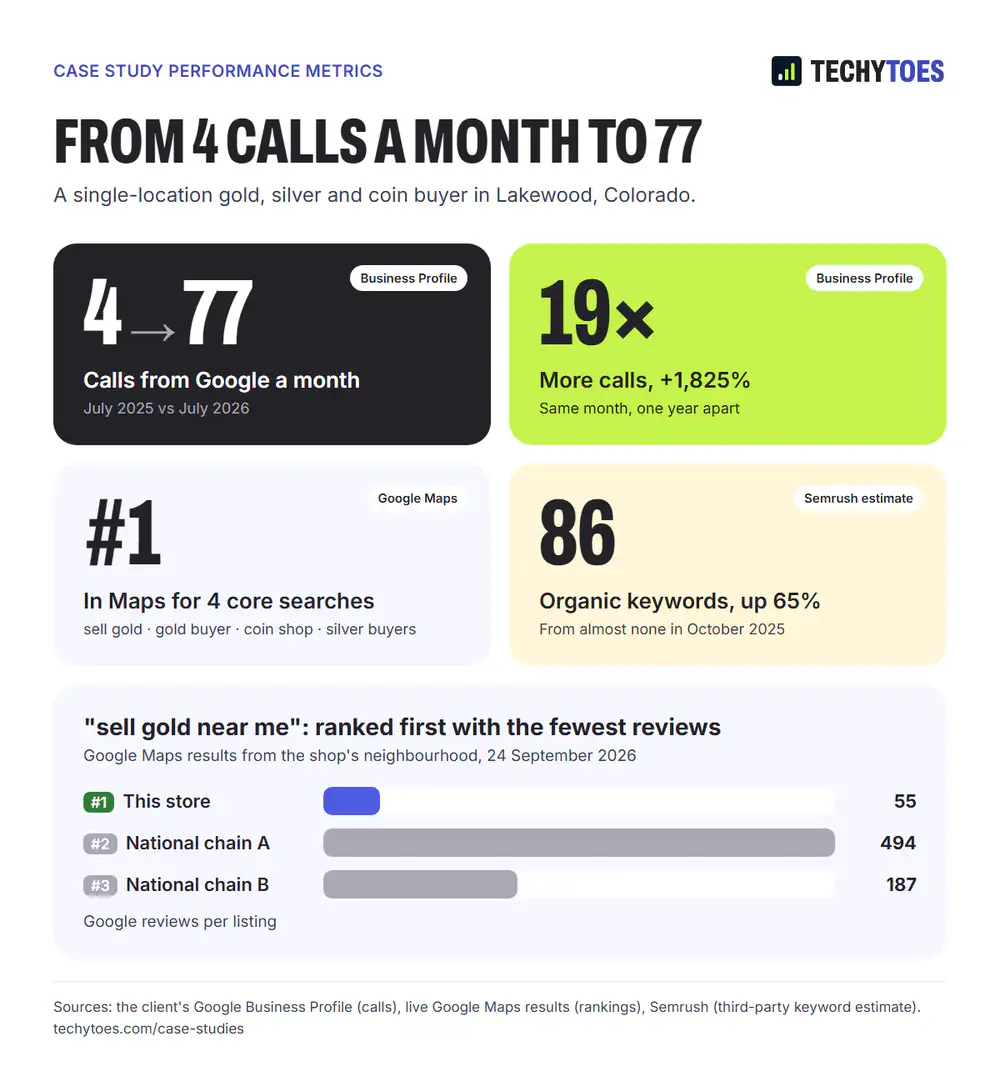
How did a single-location coin and gold buyer in Colorado outrank national chains with nearly ten times as many reviews? The answer is a focused local SEO overhaul that took phone calls from Google from 4 in July 2025 to 77 in July 2026, a 1,825% increase in a year. This lesson breaks down the blueprint that turned a hard-to-find local business into the first result on Google Maps. The video above covers it in 79 seconds. The full numbers are in the jewelry store SEO case study.
Learning objectives
By the end of this lesson, you will be able to:
- Explain how local businesses can outcompete national brands on Google Maps using strategic SEO.
- Structure a local business website around customer search intent and the towns it serves.
- Understand the role of Google Business Profile (GBP) optimization and keeping your details in sync.
- Define the three pillars behind Google Maps rankings: relevance, distance and prominence.
Decoding the map pack: why local SEO matters
For local businesses, Google Maps is the digital equivalent of a physical storefront. When someone searches for a service “near me”, they are usually ready to act, often within the hour. The map pack puts three businesses above everything else on the page, and those three get the first chance at the call.
In this case study, a gold, silver and coin buyer in Lakewood, Colorado, went from almost no search visibility in October 2025 to ranking #1 in Google Maps by September 2026 for “sell gold near me”, “gold buyer near me”, “coin shop near me” and “silver buyers near me”.
For “sell gold near me”, it ranked above two national jewelry chains with 494 and 187 reviews, while it had only 55 of its own. You don’t need the most reviews to win. You need a profile and website that match the search better than anyone else’s. (Those rankings were checked from the shop’s own neighbourhood, where being close helps too. More on that below.)
Structuring a website for human search intent
Many local businesses make the mistake of creating one generic homepage and hoping it ranks for everything. To win at SEO, you have to build the website around what your customers actually want to buy or sell.
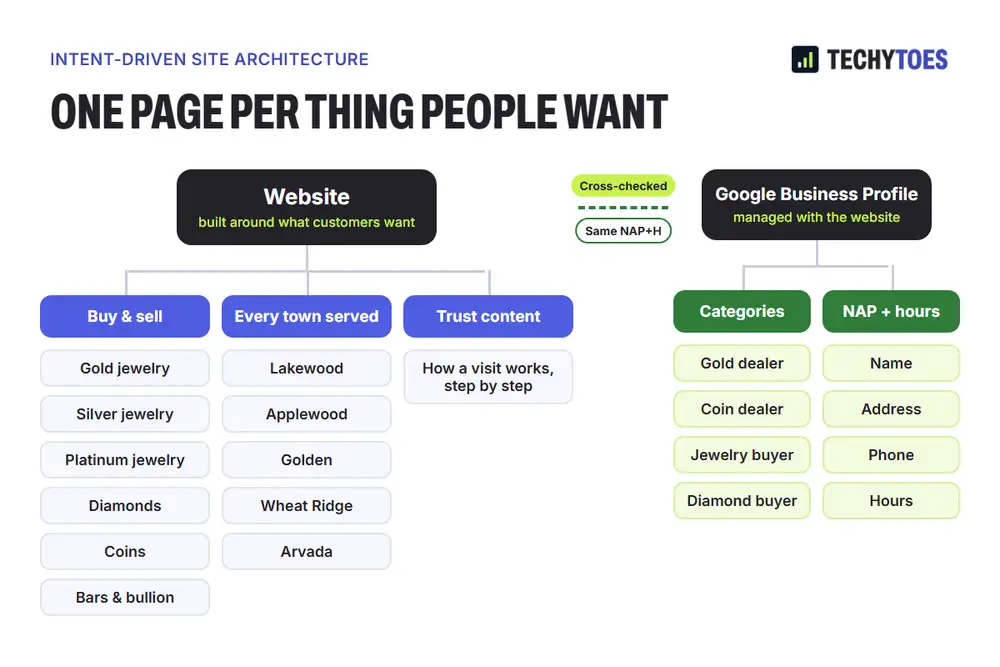
Instead of a single, cluttered “Services” page, we built separate, dedicated pages for each product category:
- Gold jewelry
- Silver jewelry
- Platinum jewelry
- Diamonds
- Coins
- Bars and bullion
We also wrote a step-by-step page explaining exactly what to expect during a visit. It builds trust and takes the nerves out of a first-time sale.
And rather than targeting several towns on one page, each town the business serves got its own landing page: Lakewood, Applewood, Golden, Wheat Ridge and Arvada. That structure tells Google exactly where the business operates and what it specializes in.
The alchemy of Google Business Profile and trust
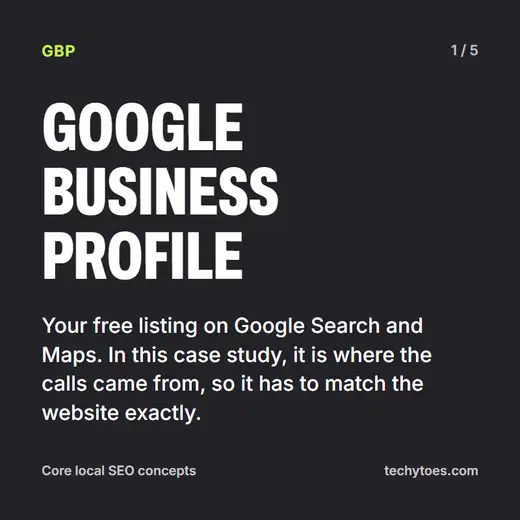
A great website is only half the battle. For a local business, the website has to work in step with the Google Business Profile. Google cross-checks the profile against the website to confirm the business is legitimate and really operates where it says it does.
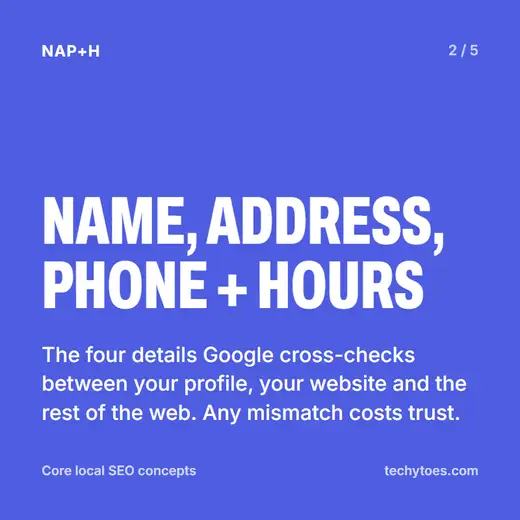
To build that trust, the business’s name, address, phone number and hours (NAP+H) match exactly on both. The profile also uses precise categories, including gold dealer, coin dealer, jewelry buyer and diamond buyer, so it lines up with every reason someone might search.
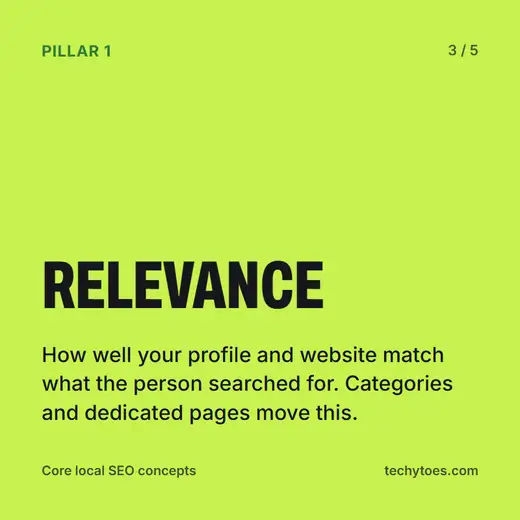
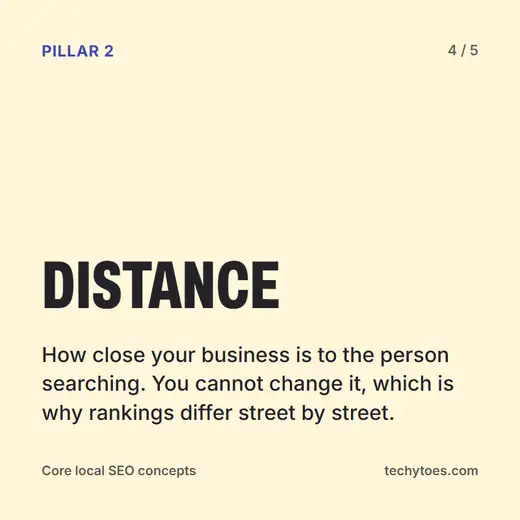
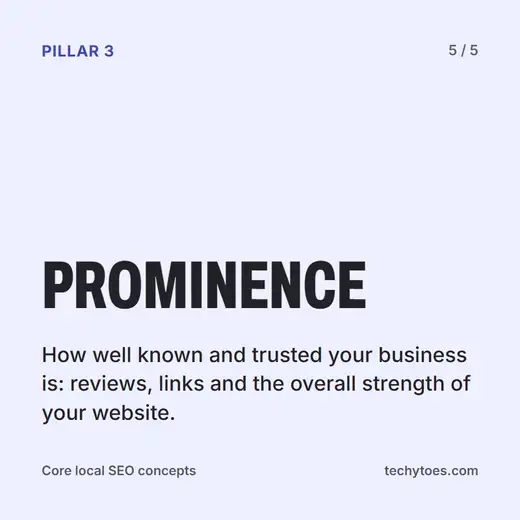
Google Maps rankings come down to three pillars:
- Relevance: how well your business profile and website content match what someone searched for.
- Distance: how close your business is to the person searching.
- Prominence: how well known and trusted your business is, from reviews, links and the overall strength of your website.
Distance is the one pillar you can’t change. By running ongoing SEO on the website and the profile together, the business pushed relevance and prominence as far as they would go. With the shop close to the people searching, that was enough to take the top spot on the map. It is the same process we use for local clients elsewhere, including our St. Petersburg FL SEO work.
Core local SEO concepts
Swipe through the five terms this lesson is built on.
Summary: key takeaways
- Structure matters. Don’t bunch everything onto one page. Create a separate page for each product category and each town you serve.
- Keep NAP+H identical. Your business name, address, phone number and hours should match exactly on your website and your Google Business Profile.
- Relevance can beat size. You don’t need thousands of reviews to outrank national chains near your own door. A highly relevant website and well-chosen profile categories can outshine much bigger competitors.
- The map is just the start. Once you lead the local map pack, go after the ordinary search results below it, to reach customers in neighbouring towns who are willing to travel.
Quiz: test your local SEO knowledge
Five questions on what you just read. Tap a question to reveal the answer.
1. What are the three pillars behind Google Maps rankings?
Relevance, distance and prominence.
2. Which of the three pillars can a business not change?
Distance. It depends on where the searcher is standing, which is why rankings can differ from one street to the next.
3. What does NAP+H stand for, and where should it match?
Name, address, phone number and hours. It should match exactly on your website and your Google Business Profile, and ideally everywhere else your business is listed.
4. Why build one page per town instead of listing every town on one page?
A dedicated page for each town gives Google a clear, specific page to show for searches in that town. One page listing five towns says little about any of them.
5. In the case study, how many calls did Google send in July 2025, and how many in July 2026?
4 in July 2025 and 77 in July 2026, a 1,825% increase, or about 19 times as many.
See the full case study
The jewelry store SEO case study has the Business Profile screenshot, the live map rankings for each search and the Semrush figures behind every number here. For more client results, see all our case studies. If you want the same blueprint applied to your business, start with our local SEO service.